Capt Amarinder Singh to Kejriwal: Accept Defeat Gracefully, Cut out the Theatrics

AAP


The excessive display of paranoia by the Aam Aadmi Party (AAP), right from its top leadership to the lowest cadres, has assumed ludicrous proportions and indicates the complete demoralization in the party in the face of imminent defeat in the recently concluded assembly elections, Punjab Congress President Captain Amarinder Singh said on Tuesday.

With AAP national convenor Arvind Kejriwal leading the way, every Tom, Dick and Harry in the party is running to the Election Commission (EC) with one or the other frivolous complaint, clear indicating that the party is preparing ground to save face following the declaration of the results, said the Congress chief ministerial candidate, in a hard-hitting statement issued here.

The Punjab Congress chief urged Kejriwal to accept his party’s defeat gracefully and not lower the dignity of prestigious institutions like the EC to cover up his own desperation.

Read full article: HERE

According to Congress, their internal pre poll survey points to around 70 seats as given above


Punjab: Voter Turnout Data Repudiates the Claim of an AAP Wave

AAP


We are repeatedly told that higher voter turnout in both Punjab as a state and Malwa as a region would be a clear indication of an AAP Wave, however invisible. Now that the all the numbers are in, we find, at the overall state level and all the three regions of Punjab, including Malwa, voter turnout declined viz-a-viz 2012. Only 6 out of 22 districts (marked in yellow or green) voter turnout was found relatively higher this year than 2012, but only three (marked green)  – Pathakot, Fategarh Sahib & Mansa where the increase was somewhat statistically significant. 

Dr Prannoy Roy’s one sample Focus Group Discussion (FGD) on the basis of which he projected a 57.5% probability for AAP win was in an assembly constituency known as Bassi Pathana, part of Fategarh Sahib Lok Sabha constituency. The hard data conclusively establishes that extrapolating Bassi Pathana as a state wise trend as Dr Roy attempted flagrantly violates all established principles of research methodology. 

The analysis also explains why Congress war room distributed ladoos and wild celebrations broke out while AAP went into a sulk after voting completion.

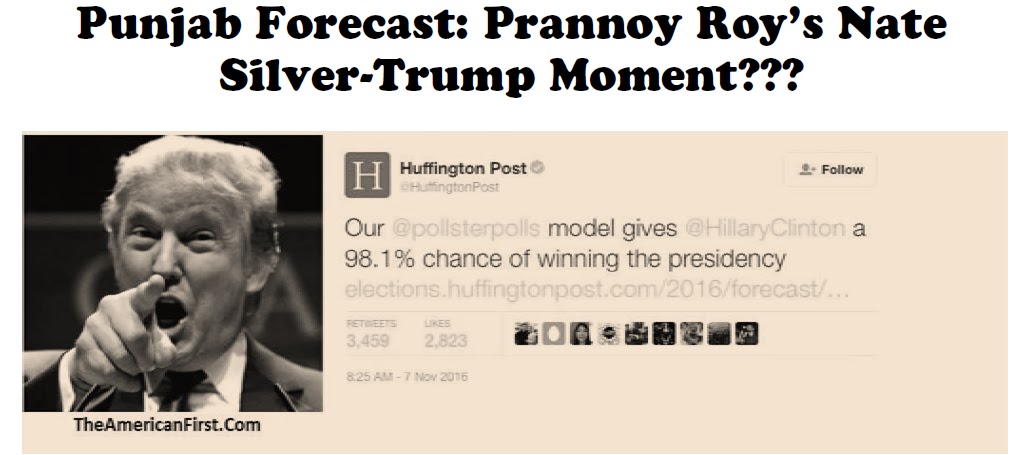
Punjab Forecast: Prannoy Roy’s Nate Silver-Donald Trump Moment???

AAP


When Dr Prannoy Roy switched from his usual votes, seats, shares and swing projections to dishing out probabilities, he was actually playing chicken à la Nate Silver of the website www.fivethirtyeight.com, an American statistician and writer who analyzes baseball and elections. He is the editor-in-chief of ESPN's FiveThirtyEight and a Special Correspondent for ABC. Silver is not merely a living icon in the US but the world over. But Silver still finally suffered his Waterloo moment with Trump’s victory.

Vote shares, seat shares, swings are measurable, reflecting a higher degree of certainty and thus lend themselves to public accountability. Probabilities are vastly different. Like Silver, Dr Roy too now can take the route to argue that his probability of AAP winning 57.5% (read here) theoretically is merely a forecast and not a prediction. The difference between the two terms is that essentially a forecast is not a certainty but just “an estimate of risk”. What is overlooked is that Dr Roy’s probability implicitly also gave AAP 43.5% chances of losing!! In short, whichever way the result went, a pollster who dishes out probabilities still can claim his forecast was spot on just as Silver continues to do so with his probabilities of the US Presidential elections last year. Never mind that millions of Nate followers took his numbers literally ended up feeling betrayed and deeply let down by their prophet! Trump’s victory also heralds the death of their prophet!

Then there is Michael Moore, internationally acclaimed documentary producer. Being a diehard Left liberal with a deep seated hatred for Donald Trump is a characteristic trait he shared with Nate Silver. But there the comparison ended. Right from the primaries when Nate dismissed Trump as a non viable candidate, Moore in contrast, even in the early days of the US primaries, warned the liberal movement of the dangers of the rise of Trump and campaigning for Left Liberal Bernie Sanders who he felt had the best prospects of trouncing Trump. But unlike Nate who used numbers, Moore relied on more qualitative interpretative arguments. It is easy to get carried away with numbers and as a result, the liberal movement preferred to embrace Silver’s forecasts with both hands and chose to dismissively ignore Moore who in hindsight is now widely accepted had been perceptibly right on target.

Today in India we have a choice. Either go for dazzling numbers dished out by the likes of Prannoy Roy, Yashwant Desmukh etc or go by the field reports of old time style journalism from the likes of Shivam Vij, Prashant Jha, Rohini Singh and so many like them who provide us interpretative answers and not so much solid but meaningless numbers. I have many times jokingly tweeted to Yashwant Deshmukh that I have not much faith in the numbers that his CVoter dishes out but have complete admiration for his more substantive analytical election related articles. This I suppose holds equally true for all truly psephology freaks, rather than numbers, go by the analytical reports of the likes of Yogendra Yadav, Sanjay Kumar and CSDS rather than seductive topline numbers of Today’s Chankaya, AC Nielson and their likes.

Provided below are extracts from an excellent article by Marlena Trafas in the Weekender on lessons learnt from the last US Presidential Elections 

While there are many explanations for how Trump got elected, two stands out in particular for how well they exemplify the failure of numbers to fully explain the complex world we live in. One explanation comes from resident Numbers Guy, Nate Silver, the founder and editor-in-chief of FiveThirtyEight, a site that “uses statistical analysis — hard numbers — to tell compelling stories about politics, sports, science, economics and culture.” The other explanation comes from liberal filmmaker and author, Michael Moore.

A week after the election, Silver appeared on The Daily Show and was interviewed by the host, Trevor Noah. The interview began a bit awkwardly as Noah says to Silver, “Let’s talk about polling. You’re not a pollster, you aggregate the polls. This entire race you were wrong.” To that Silver responds, “No,” and the entire audience erupts with laughter.

This audience response makes perfect sense, as it is now clear that all the predictions and forecasts and probabilities that expressed very little chance of Trump winning the presidency were wrong. Now, Silver wouldn’t say they were wrong. In fact, his entire interview with Noah is a defense of the polls he used, saying there’s “not an easy television explanation,” saying these were “some of the best polls,” and that his “forecasts” were actually not “predictions,” but “an estimate of risk.” He describes percentages and “if this, then this” explanations based on calculations, maintaining that if there were a 30 percent chance of rain, people may bring out their umbrellas, thereby suggesting that people should’ve been worried about the 30 percent chance of Trump being elected.

Despite Silver’s reasoning, many everyday people took his numbers to mean that Trump in fact had no chance of winning. Silver argues that people shouldn’t have thought that based on the numbers he provided. It’s this frustrating, circular, contradiction that leads to Noah’s exasperated ending joke, “I’m gonna choke you right now, Nate Silver.” If one watches the interview, it’s clear that all the smart talk Silver delivers never really feels like a true answer or explanation.

When compared with Moore’s “5 Reasons Trump Will Win,” Silver’s numbers become abstract and meaningless as they translate why Trump will win into zeroes and ones. Moore, unlike Silver, uses words — qualitative evidence — history and sociology to explain the human behavior and feelings that would lead to a Trump presidency.

Moore’s reasons range from “The Last Stand of The Angry White Man” to “The Depressed Sanders Vote,” and reading through them on his website makes it it hard to discount the fact that they make sense — definitely more sense than Silver’s mathematical explanation. Moore’s explanations are ones people seemingly only came to fully realize after the election. But Moore made his prediction in the summer of 2016. And very few people seemed to take him seriously. The days before the election I heard hopeful, confident talk of a Madam President, not wariness about the “Angry White Men” who would vote for Trump because they felt left behind by the current cultural-political moment.

Put simply, the guy who used numbers and data and stats incorrectly predicted the election and the guy who used words, history, and qualitative facts correctly predicted the election., Leading up to Nov. 9, many hopeful liberals put their faith in Silver’s numbers rather than Moore’s words to explain how humans would act that Tuesday. The numerical data was trusted and the numerical data let a lot of people down.

While there are many lessons to take away from the election of Donald Trump, one is that numbers can lie. Math and stats and data points don’t always tell it like it is. Sometimes you need interpretative answers rather than the “correct” answer. Sometimes the guy spouting words and using simple addition has a keener sense of the forces that govern our society than the one using statistical analysis.

Read the full article: Here


Why Prannoy Roy’s U-Turn on his Punjab forecast does no justice to his reputation as a master pollster

AAP


Anybody who takes a keen interest in psephology must be familiar with Dr Prannoy Roy, who is credited as the first psephologist in Indian media - the man who created a bench mark for poll prediction. He burst into the scene during the 1984 Lok Sabha elections when together with and economist Ashok Lahiri, soon after Indira Gandhi's assassination, when as a Doordhasan anchor with Vinod Dua, he hit the bullseye predicting the actual seat number of the Congress scored.

From then onwards, Prannoy Roy has been at the helm in NDTV carrying out incisive reviews of exit polls and opinion polls of every general elections held since 1988. Many of us who tracked Prannoy Roy's predictions ended up getting lifelong bitten by the bug of psephology and still consider him the master psephologist in the country.

Imagine the shock many of us felt when in a span of just 3 days, Prannoy Roy made a radical inexplicable U-turn regarding his Punjab Assembly predictions as summarised in the table below


Yashwant Deshmukh, founder psephologist of CVoter perhaps gave vent to expression to the degree of shock and awe which all of us fans of Dr Roy felt by this singular tweet

“Dear Dr Roy, you inspired people like me to pick psephology as career. But this stuff is not helping. Probabilities need some kind of base.”

Yashwant Deshmukh hit the nail on its head  - the basis for probabilities is not made clear by Dr Roy. The dangers of using probabilities as a tool can be illustrated how Nate Silver of the website www.538.com overnight lost his iconic status within the psephology industry to be reduced as an international laughing stock. Trump won despite Silver giving him just 20% winning probability! This when unlike Dr Prannoy Roy, Nate Silver elaborated the basis of his probability calculations very comprehensively. 

The moot question is what has radically changed within a span of just 3 days for Prannoy Roy to compel him to make such a radical revision of probability distribution of contending political parties winning chances?? 

A Single FGD is a sample?

What is extremely shocking is that Dr Roy undertook a radical revision of the probabilities he dished out only three days earlier based on a single sample Focus Group Discussion (FGD) in one village. How can the robustness and representative character of this sample be defended in terms of psephology or research methodology? 

Misleading to Categorise Bassi Pathana as “Predictor’ 

The only detail Prannoy Roy shared about the single sample is that it was one among the several ‘predictors’. He explains that a ‘predictor’ constituency was one which consistently votes with the tide viz the winner. There are two problems come across. Punjab had been a bi-polar contest between SAD and Congress from inception. Only in 2014, AAP made it a tri-polar contest, where SAD-Punjab won 6 out of Punjab’s 13 Lok Sabha seats to AAP’s 4. Bassi Pathana was one of the constituency leads for AAP and accordingly does not qualify by Dr Roy’s own definition. So why was it misleading categorised a ‘predictor’?

Character of Bassi Pathana as a Sample

1. Bassi Pathana falls under Fatehgarh Sahib Lok Sabha constituency which is one of the four constituencies which AAP won in 2012 by nearly 6% margin.


2.   If we were to go to Assembly leads during Lok Sabha 2016, we see once again AAP sweeping Bassi Pathana constituency by around 12%


3.  The AAP candidate is Santokh Singh Salana, a controversial individual. The Indian Express exposed Salana being dismissed from service. Salana worked as a canal patwari in Sutlej-Yamuna Link Water Services Circle, Ambala, was “absent” from duty for almost four years, following which he was “dismissed”. Salana had earlier claimed that he had quit on his own own. This together that he was outsider prompted local AAP cadres to revolt against his getting a ticket. 


Character of FGD members

Coincidentally this happens to be a SC reserved constituency. AAP’s candidate Salona had been a former BSP leader and thus in a constituency where Dalits are numerically the largest single caste, this gives AAP a huge popularity advantage. In 2012, AAP canabilised most of the Dalit votes from both the BSP and Congress to chalk up nearly 40% lead in Bassi Pathana. What did the FGD members which the NDTV team met with look like? Dalits.

NDTV data also tells us that the Congress tends to have a relative advantage in urban areas while AAP in rural areas. Where did the NDTV team conduct their single FGD? Rural Area!!


The findings of NDTV do not meet the methodological vigour standards of serious research and on the face of it appear to be smacking heavily of deliberate sampling bias. Bad enough the sample is not representative but its selection favoured AAP as the constituency is one of the bastions of AAP. 

Even if the FDG were to be otherwise a representative sample of Bassi Pathana, it does not lend itself to extrapolate the results to fit the entire population. And why is this? According to NDTV’s own data, AAP is mainly an East Malwa phenomenon and relative to the Congress, a marginal player elsewhere in the state. 

AAP is most likely to win big in constituencies like Bassi Pathana where voter turnout recorded yesterday was a whopping 77%. At the macro level this would distort the perception of its vote share looking stronger than they are actually. This is because their vote share distribution is highly uneven. AAP will win constituencies like Bassi Pathana big – 50-60% but in the first past the post system, the extra votes are wasted votes. 

Calling wrong an odd poll or two doesn’t affect the status of icon in the polling industry. As long as you have a strike rate 6-8 out of 10, a person with a track record as Dr Prannoy Roy would continue to rule the roost as the leading pollster in the country. But this U-turn in Punjab predictions within a span of three days is definitely going to cost Prannoy Roy his credibility as a pollster. AAP may or may not Punjab. That is secondary. But Dr Roy needs to do is to explain the reasons for his surprising U-turn. At least Nate Silver since November have been trying to explain himself. The question is whether Dr Roy would find the courage and the need to do the same.


Like us on Facebook

Follow us on Twitter