Goa: The Silence of the Voter an Engima for Polical Parties

AAP


If you ask any political party, they will tell you that they will be in a position of strength to form the next government. Bharatiya Janata Party (BJP) has claimed they will win 26 seats, Congress feel they will get 23, the Aam Aadmi Party (AAP) has made positive claims of their own and the Maharashtrawadi Gomantak Party (MGP) has made no secret that they cannot be ignored when forming the next government.

But word on the street, at tintos and in the market place is completely different. Eight days after Goa went to polls, there is no clarity. It is still the "silent voter" who holds the key and the "silent voter" has not given any indication which side the wind is blowing.

That has left political parties in a fix. Everyone is wondering whether it will be a hung assembly. Will the BJP ride the anti-incumbency factor to win again? Will a resurgent Congress surpass its own tally? What about the independents? And if they get elected, who will they back? 

"I have never seen such anger against any party, the way it was against the BJP. People wanted to punish the party leaders for taking them for a ride," said Velingkar, who damaged the image of top BJP leaders more than anyone else this election year.

Velingkar's anger towards the BJP is understandable, but does he have a point?

What went wrong for BJP? 

The government's slew of schemes and doles may have earned solid support but anger against the party was strong elsewhere. BJP's backtracking on some key issues ranging from special status and recovery of illegal mining loot to unemployment doles of Rs 4,500 per month and zero tolerance to corruption irked voters, poll watchers say. Demonetization, despite official bravado, was also a factor, particularly in rural areas.

"Polling day was payback time for the common man who suffered miserably. We had to stand in queues instead of going to work and even then we were unsure of withdrawing Rs 2,000. Worse still, the government said people didn't suffer and tourism was not affected," a voter said.

MGP leader and chief ministerial candidate, Ramkrishna 'Sudin' Dhavalikar, also appeared to have had enough of the BJP. "We had never seen such arrogance of their workers," he said. 

Strategic voting

Strategic voting too is not ruled out in some constituencies. Voters who earlier didn't have any love for the Congress eventually voted for the 'Hand' because they didn't want BJP in power. Ditto with extreme right-wing voters, who were inclined towards the MGP-GSM combine but put their trust in the 'Lotus', though on a smaller scale, in a clear attempt to keep Congress - with MGP backing - away.

Read the full article: HERE

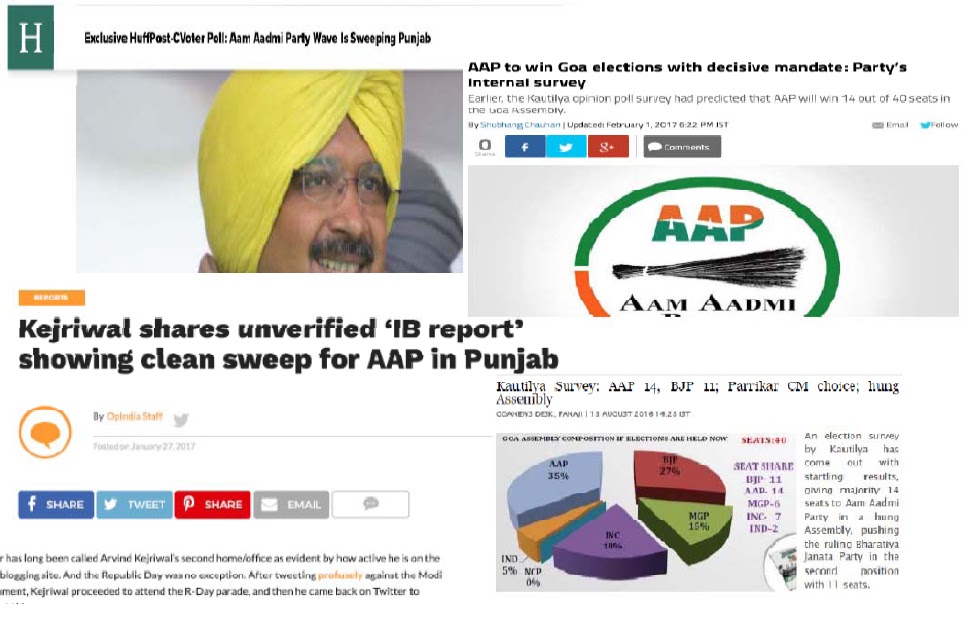
Ashutosh tacitly concedes AAP lost Punjab & Goa. But why lash out at opinion polls?

AAP
Ashutosh one of the top leaders of AAP just tacitly conceded defeat in both Punjab and Goa. 

”Are opinion polls rigged in India, or are they done by those who have no expertise? It is a very uncomfortable question, but the time has come to ask it. It is a tough question for a person like me who spent two decades dissecting the political climate, especially during elections. 

Nothing can be more engrossing than discussing which political party has an edge over others and has a brighter chance of forming the government, who is the most popular leader likely to be Chief Minister or Prime Minister, what are the most important issues that can shape the result. 

There was a time when opinion polls were keenly awaited, the political class observed them keenly, and very few agencies were used to conduct polls. Some did go wrong, like in the mid-80s, when opinion polls predicted the defeat of Devi Lal who in fact returned victorious. Except the occasional criticism, though, nobody questioned their veracity. The same cannot be said today.”

 Read full article: HERE

The ballot box when opened often holds huge surprises as we winesed recently during the recent US Presidential elections when Donald Trump overcome all odds to chalk up in the end a very facile win over Hillary Clinton. So who knows? Even if it might be a long shot, AAP may still win either Goa or Punjab even if their ground feedback may tell them now that they have very little chance.

But that isn’t the main story. It is Ashutosh choosing to launch into a blistering attack on opinion polls who he blamed for marring AAP’s chances in both Goa and Punjab. 

The BJP in 2004 tried through pre polls to build up an atmosphere of invincibility and an impression of inevitability of their victory and yet bit dust. More recently, in Bihar the Mahagathbandhan was mostly given no chance by opinion polls to win, but nevertheless defeated pollsters to chalk up a landslide win. AAP themselves won Delhi defying pollster predictions. This illustrates that though polling agencies and media might be exactly as Ashutosh described them, they are no way an impediment when a political party or candidate have people on their side. They win or lose despite and inspite of opinion polls. Ashutosh’s outburst accordingly appears as one of sour grapes, whining in public, a trait AAP often demonstrates.  

There are many things Ashutosh described of Indian polling agencies which I in fact personally is in full agreement. Yet, AAP is perhaps the last political party who should complain of use, misuse and abuse of opinion polls, since they undoubtedly maximally use such polls as electoral propaganda. This is what Goa Herald in an editorial rightly commented:

“But AAP has lost the right to play this card in Goa. It has lost the right to dismiss an unfavourable opinion poll because of the manner in which it has embraced an earlier favourable one. If it wants to be received as a party with any degree of honesty, it should have the courage to treat all opinion polls equally- either go by them or dismiss them. You can’t swim with a favourable one and refuse to sink with the unfavourable."
 

Goa Herald: Cong poised for near majority as mood swings in State

AAP


In what initially appeared to be difficult to comprehend, there is a clear change in the political weather with the Congress getting a very strong wind which could push it to close to a majority.

Herald travelled across constituencies in both regions of the State. Between 2012 and 2017, there is a palpable change. While in 2012 there was wave which got the got the BJP to power, 2017 is about local winds in each constituency moving away from them. And in a growing number, the shift is towards the Congress.

Each local area and its local people are looking at first at very important local factors which have affected their lives and are taking their decisions to vote differently. For instance, in the BJP stronghold of Sankhalim, Herald saw hordes of mining affected, from truck owners to truck drivers, those who have lost their livelihoods completely moving with the Congress candidate, saying, “Everything depended on mining restarting to the extent that our tucks would get enough business. From truck owner to truck driver, we are on the road.”

The other common refrain has been the inability to procure and keep jobs in this regime. This cannot be underlined strongly enough. This continues to be complaint number one from Pernem and right down to Canacona. In Pernem for instance, the locals were promised 500 jobs per year during the 2012 elections. In five years, not more than 700 jobs have been allotted according to locals who know.

While the broader issues like failed promises, destruction of Goa, corruption in government, have made peripheral impact, the very local problems, bottlenecks and difficulties, like health care, roads, power, availability of water, have impacted people.

The sentiment towards the Congress is interesting. For instance an elderly couple (who chose not to come on record but shared their details for reference) from Aldona told Herald on Tuesday morning, “We punished the Congress in 2012. They have finished their sentence. It is time to take them out and allow them to serve us.” Asked the reason for this confidence, the husband said, “They will not make the same mistakes, we feel.” And with this, at least one extended family of theirs has made their decision.

In terms of numbers, the Congress seems to be getting two things right: 
A)    The almost sure possibility of retaining their previous seats, like Valpoi, Poriem, Curtorim, Taleigao  and Margao.

B)    A very high chance of getting Ponda, Shiroda, St Andre and Navelim back

C)   Making earlier unexpected gains, which could lead to victories in Tivim, Panjim, Nuvem, Aldona, Sankhalim, Cuncolim and even Mandrem  
        The party will look towards cashing in on this momentum, as it sees fighting a good battle in other seats.

The challenge and also the hope of the Congress is to overcome the problem of splitting votes. But this is something only the people can handle. It doesn’t matter how many Independent candidates or fringe parties that are in the fray across the constituencies. Elections are won or lost by people, not parties. The result of 2017 will be all about whether a decisive mandate is delivered.

Goa Assembly Polls 2007: Fuzzy Pre-Polls. Congress the Dark Horse

AAP


From the clutch of opinion polls published, what is obvious to the eye is collectively a lack of statistical consistency. 

Most polls however give the edge to BJP, with the Congress as their main challenger. The most inconsistent projection is that of AAP. The majority polls dismiss AAP as only a marginal player, but one or two put them actually leading!! In either case, AAP is BJP’s insurance to ensure non-BJP votes are split, which gives BJP an edge. That AAP itself do not believe they can win or come second is underscored by the fact that most of their top national leadership is camping in Punjab rather than Goa. Compared to Delhi, the AAP campaign impact had been pedestal to propel them as a major player in the state.

Most of the pre-polls were undertaken before the Congress got its act together and started its campaign. Rahul Gandhi’s rallies were the biggest that neither Kejriwal nor Modi could match. The vote base of the Congress and AAP overlap in terms of minority votes. While much has been written in the media of AAP grabbing the Christian base of the Congress, the feedback from the ground suggests that AAP is actually grabbing more the section of Christians who voted the BJP in 2012 rather than making any significant inroads into the Congress minority base. In that sense it is doing a favour for the Congress by eroding the BJP vote share. While Congress has a much wider social base, AAP’s Hindu base is practically non-existent. Without it, AAP cannot be expected to logically to either win or pip the Congress to the second spot. The Congress and not AAP can be expected to be the dark horse in the race where the BJP appears to have slight edge.  Accordingly, because of this there is a good possibility of those anti-BJP voters who might vote Congress only because AAP is seen as a voter splitter. 

Goa Congress is not in great shape, yet it seems to be gaining, owing to perceived anti-incumbency of the Parsekar government. Despite the perception of comatose, pollsters are of the opinion that the Grand Old Party will see a rise it its seat tally. The question is how much can it gain? That would depend on to what extent both BJP and AAP vote share decline. The lower their vote share as projected by polls, the higher the Congress strike rate and vice versa. 

That these published polls are not reliable is hinted by veteran and respected pollster, Shanta Kumar in a recent article which we are reproducing below.     

BJP may struggle to regain power in Goa  
By Shanta Kumar, CSDS 

It is battle of nerves for the BJP and the Congress in Goa, a small state with just 40 assembly seats. Going for the poll on February 4, what is unnerving strategists of these two national level parties is the presence of a rookie, the Aam Aadmi Party (AAP) which has potential enough to turn the apple-cart of any established player. Shorn off any electoral base or ideology, the AAP is focusing its energy in cornering youth who appear to be disillusioned with both the ruling BJP and the Congress.

This has turned traditional bastion of the BJP and the Congress into three-cornered contest. Records show that whenever there is a three-cornered contest, the AAP has outshined others. But Goa is not Delhi, nor is the state’s ruling dispensation facing controversies as seen with the Sheila Dikshit government in Delhi, resulting in voters turning towards Arvind Kejriwal-headed AAP for redemption.

However, what may prove costly to the BJP and its government in the forthcoming election is the on-going fight between the party and its parent body, the Rashtiya Swayamsevak Sangh (RSS). The reason behind their squabbling is Goa’s BJP-led government’s refusal to follow the RSS’s dictates on an issue related to medium of instruction in primary schools. The Sangh wanted implementation of Konkani and Marathi as mediums of instruction. Instead, the BJP government under Manohar Parrikar earlier and Laximikant Parsekar later continued with English as a medium of instruction in primary schools in order to keep local Christians in good humour.

Upset with this, the RSS has announced that it would not support the BJP in Goa. In this circumstance the onus has shifted to the BJP’s central and state leadership to steady the party’s ship in the turbulent political waters of the state. On the other hand, the Congress is in no mood to compromise its chance this time. The overall concern in the state, however, is political instability. Between 1990 and 2002, 13 governments have ruled the state. With the arrival of national parties like the Congress and the BJP in Goa, though, chances of instability have declined, yet they have not completely vanished from the political character of the state.

Which party will win election?

Twenty one seats are required to form a government in Goa. Although the BJP, the Congress and the APP have put their energy, resources and men to corner as many seats as they could, it is the MGP which is ready to spoil the electoral broth. The regional outfit, known for its conservative Hindutva outlook has decided to contest on 26 seats, leaving the rest for alliance partners like the GSM and the Shiv Sena.

Sharad Pawar-headed Nationalist Congress Party (NCP) and regional outfits like the Maharashtrawadi Gomantak Party (MGP), the United Goans Democratic Party (UGDP), the Goa Vikas Party (GVP), Goa Forward Party (GFP) and the Goa Su-raj Party (GSP) are also in the fray. The Congress which had initially announced contesting polls on seat-sharing basis with the GFP, has now decided to contest election on 37 seats. It would support Independent candidates on the rest three assembly seats.

The party has also decided against projecting anyone as chief ministerial face. It is banking on senior party leader and former Goa Chief Minister Digambar Kamat to bounce back to power, the possibility of which appears a bit remote in the background of weak organisational strength of the party in the state. If the BJP loses election in Goa, it would be greatest setback for the saffron party, because the state is considered as a formidable bastion of the party after Gujarat.

Despite being handicapped by the nonsupport from the RSS and facing stiff challenge from the Goa Suraksha Manch (GSM) which is a hardcore Hindutva outfit, the saffron party is hopeful of re-scripting victory again. Possible division of votes of Christians, constituting more than 25 per cent of the state’s total population, between the Congress and the AAP, is the reason behind the BJP’s optimism. But then it is the AAP which is equally looking formidable in the state. Distribution of ticket to candidates much before the election was declared, has given candidates of the AAP an opportunity to familiarise themselves with the voters. Besides, unlike the BJP and the Congress, the AAP has not desisted from projecting the party’s chief ministerial face in the election. Elvis Gomes, a former bureaucrat, has been declared as AAP’s chief ministerial face.

Electoral strategy of each party

The AAP is focusing on youth, farmers, women and middle class to achieve high electoral gains. The party’s manifesto talks about ridding the state of casinos, gambling, drugs and prostitution rackets. It promises about making Goa a corruption-free, putting corrupt miners behind bars and recovering Rs 36,000 crore that the state has lost on account of illegal mining. The party has also promised bringing in land reforms in the state. Adopting its time-tested door-to-door campaigning method and street dramas to reach out to the voters, the party has promised to do away with protection given to the coconut palm in the name of it being as a forest tree.

The BJP, like elsewhere, has adopted a ‘top-down’ strategy in Goa in which top central leaders like Prime Minister Narendra Modi and Amit Shah address big rallies and then local leaders go door-to-door to meet the voters. By organizing “Vijay Sankalp” rallies, the party has already built momentum across the state. In the 2012 assembly polls, the party had won 21 seats on its own in Goa. In North Goa, it remained victorious in 13 seats. Also, its performance in Christian-dominated South Goa was up to its expectations, winning as many as 8 seats from this part of Goa. This time, given the Goan Churches’ unhappiness with the BJP, despite the state government’s decision to stick to English as a medium of instruction in primary schools, it does not seem that the BJP may be able to perform well in South Goa.

Development and good governance are two key planks of the party which is banking on Defence Minister Manohar Parrikar’s image and reputation to pull out a victory, even though it has not declared anyone as its chief ministerial face in the election.

However, it is the Congress which is trying to cash in on public resentment, especially on employment, legalising of illegal mines and others. Whether the party’s populist schemes like free-electricity to slum dwellers may be able to cut much ice are in the realm of speculation. Development and stability are among the main poll planks of the party.

Key electoral issues

Migration of people from Maharashtra, Karnataka, Uttar Pradesh and Bihar and its impact on Goa’s culture is one of issues concerning people in the state. Drug trade and its linkage with the state’s casino business is another major worry of the people; as such they have demanded closer of casinos. Problem of dual nationality faced by Goans is also a key issue.

Conclusion

Even as demonetisation and its consequent impact on cash flow along with the Election Commission’s strict vigil have hit Goan politicians hard as they are not able to reach out to voters as easily as they want, the forthcoming polls are acid test for the ruling BJP. While it has to prove that it can survive the election without the RSS’s support, it has also to ensure that Modi’s magic has not waned.

However, the saffron party can pat its back for the moment as majority of opinion poll surveys show the BJP gaining in the election. Poll survey of India Today-Axis shows the BJP getting 20-24 seats, the Congress 13-15 and the AAP 2-4 seats. Another survey conducted by VDP Associates shows the BJP winning 22 seats, the AAP 9 seats and the Congress 6 seats. But poll surveys or exit polls have in most cases proved wrong in their calculations.

The 2016 presidential election in America is a case in point. None of the poll surveys conducted by newspaper houses or TV channels ever projected Donald Trump as America’s 45th President, but when the results were out, Democratic candidate Hillary Clinton was not the one whom surveys had declared Barack Obama’s successor.

Like us on Facebook

Follow us on Twitter