Maharashtra Civic Polls: Shocking EVM Counting Discrepancies

BJP


A series of “coincidences” cast a huge cloud of doubt on the freeness of the election process during the recent Maharashtra Civic Poll. 

It was much publicized that CM Devendra Fadnavis had to hastily skip his Pune rally as being greeted by empty chairs. Pune was never a stronghold of the BJP. In fact, BJP was reported to virtually struggle to get crowds for their rallies in Pune. And yet to the surprise of all including voters, BJP emerged the largest single party in Pune. BJP MP Sanjay Kakde, who had played a crucial role in getting criminals into the BJP fold, had accurately predicted the results for Pune. He had vowed to give up politics if his prediction proved wrong. Opposition parties now cite this claim as proof that the ruling party had manipulated the poll results.

It is very difficult at the civic poll level to hit a bullseye in poll prediction for a number of reasons. CVoter last year turned out an excellent performance hitting the bullseye for the Bangalore Municipal Corporation (BMC) polls in respective to vote share but did not show similar accuracy with seat shares since at the civic poll level, seats are won and lost by margins as low as single digits! But in the recent Maharashtra Civic Polls, a well known polling agency missed their vote share prediction by a mile [those predicted being much higher than their touted Margin of Error (MoE)] but hit a bullseye with their seat predictions!!

And these are citing just two coincidences. And there are several more horrifying such coincidences and controversies which this QUINT article below talks about. The question is what if these controversies get repeated in the March 11th results of the 5 State Assemblies???


On the evening of 23 February, an unexpected development shocked Maharashtra as counting for local body polls in the state was ending. Violence erupted in Panchavati in the heart of Nashik city following complaints of tampering of EVMs (electronic voting machines).

The city BJP chief’s son was declared the winner from the ward, but the Shiv Sena claimed that the total of the votes received by each candidate exceeded the total number of votes cast.

This led to clashes between Shiv Sena and BJP workers in the streets. Soon, mobs began vandalising and burning vehicles. Police had to resort to lathi-charge and firing in the air to disperse the crowd of 800 people. Nine policemen, as well as some local residents, were injured in the rampage.  


A similar charge of EVM fraud swirled in Pune, only the reaction was thankfully non-violent. In Yerawada ward, 15 candidates from different political parties registered a complaint against the Returning Officer (RO), alleging “misappropriation” of EVMs during the counting of votes.

They claimed that a total of 33,289 votes were cast, but 43,324 votes were counted. They demanded a re-poll using ballot paper. A police complaint has been registered against the RO.

As the State Election Commission, which conducts local polls, turned down the demand for re-polling, a united opposition first held a protest meeting. As more cases emerged, they took out a mock funeral procession of replicas of EVMs on Tuesday, which were then symbolically cremated at the Vaikunth crematorium.
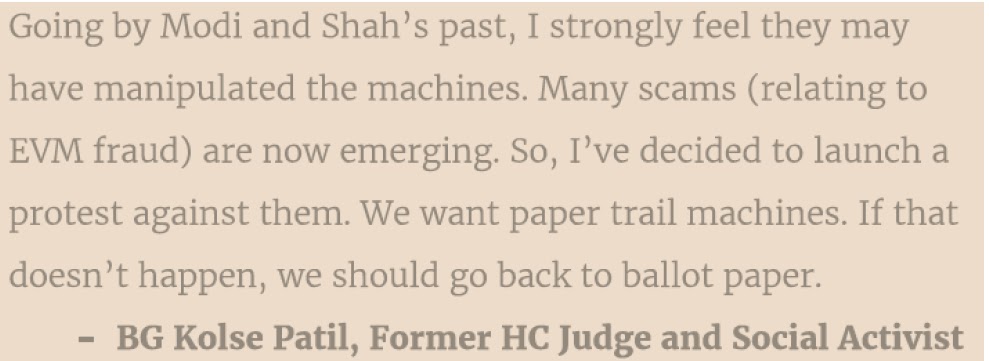

In Mumbai, independent candidate Shrikant Shirsat got zero votes at the booth near his residence in Saki Naka in the western suburbs.

Similar complaints are being reported from various parts of the state. Efforts are being made to collate data. A body called the Lokshahi Bachao Andolan has been formed in Nashik to collect data related to alleged tampering of EVMs.

In Nagpur, the NCP has threatened that it won’t let the mayor take oath unless an inquiry is conducted into the “EVM scam”. In nearby Amravati, an all-party bandh was called on Monday over the use of EVMs. It received a good response, with market places remaining closed.

Read the full story: Click HERE


UP Elections: How Reliable On-the-Ground Reporting? Part1-Introduction

AAP


One of France’s leading newspapers has given up on public opinion polls ahead of France’s presidential election in April, and its reasoning, it says, comes down to two recent, unforeseen events: President Trump and Brexit. Stephane Albouy, Le Parisien’s editor-in-chief, said that they

want to avoid giving the sort of commentary that accompanies a horse race, always focusing on who is in the lead.  Commissioning opinion polls now is useless because they will have no bearing on the final result. This doesn’t mean that we are against polling, but we prefer to focus our political analysis based on what we see and capture on the ground, rather than rely on opinions that have yet to fully develop over the course of the campaign.”

Coincidentally, with the Election Commission ban on publication of exit polls of the on-going long drawn out 7 Phase UP elections, those interested to track the electoral battle had no option but forced to depend entirely upon on-the-ground reporting. Unfortunately, exceptions aside, most of this on-the-ground reporting seen so far tends to ape the pollsters’ favourite horserace format that provides the framework for analysis where a horse is judged not by its own absolute speed or skill, but rather by its comparative speed of other horses, and especially by its wins and losses.

Like opinion polls, media outlets have often resorted to horse-race journalism with the intent of making elections appear more competitive than they are to spur their readership or to favour a political party who they are aligned to. They often take to politically handicapping stronger candidates or hyping dark horse contenders to influence public perceptions and in turn voter behaviour. Very often their reports have the same effect of push polls that are designed more to influence voters’ opinions rather than measure them. And we may have seen them all this elections. 

Like pollsters most of these feed on the hunger of their readership for certainty, setting off expectations that are basically impossible to meet. The thing is voters are inherently unpredictable. Yet, we see as if by led by strong compulsive pressure, on-the-ground journalists tend to be compelled to tell us who is going to triumph at the polls than try to understand and capture what is going on at ground level and the mindset of voters. Rather than sticking to reporting, the emphasis shifts on more commentary, which is basically subjective reasoning than hard evidence. Extrapolating macro trends from often unrepresentative sample of respondents at the micro level slips them immediately into hazardous journalism zone. Nevertheless when these journalists also dip into their storytelling toolbox, the net effect often makes their reports any day much more fascinating and insightful reading than the mere numbers pollsters bombard us. They give us additional information such as revealing the factors, motivations, and reason why particular groups of people support which candidate or party and how these factors are likely to play out in their opinion.

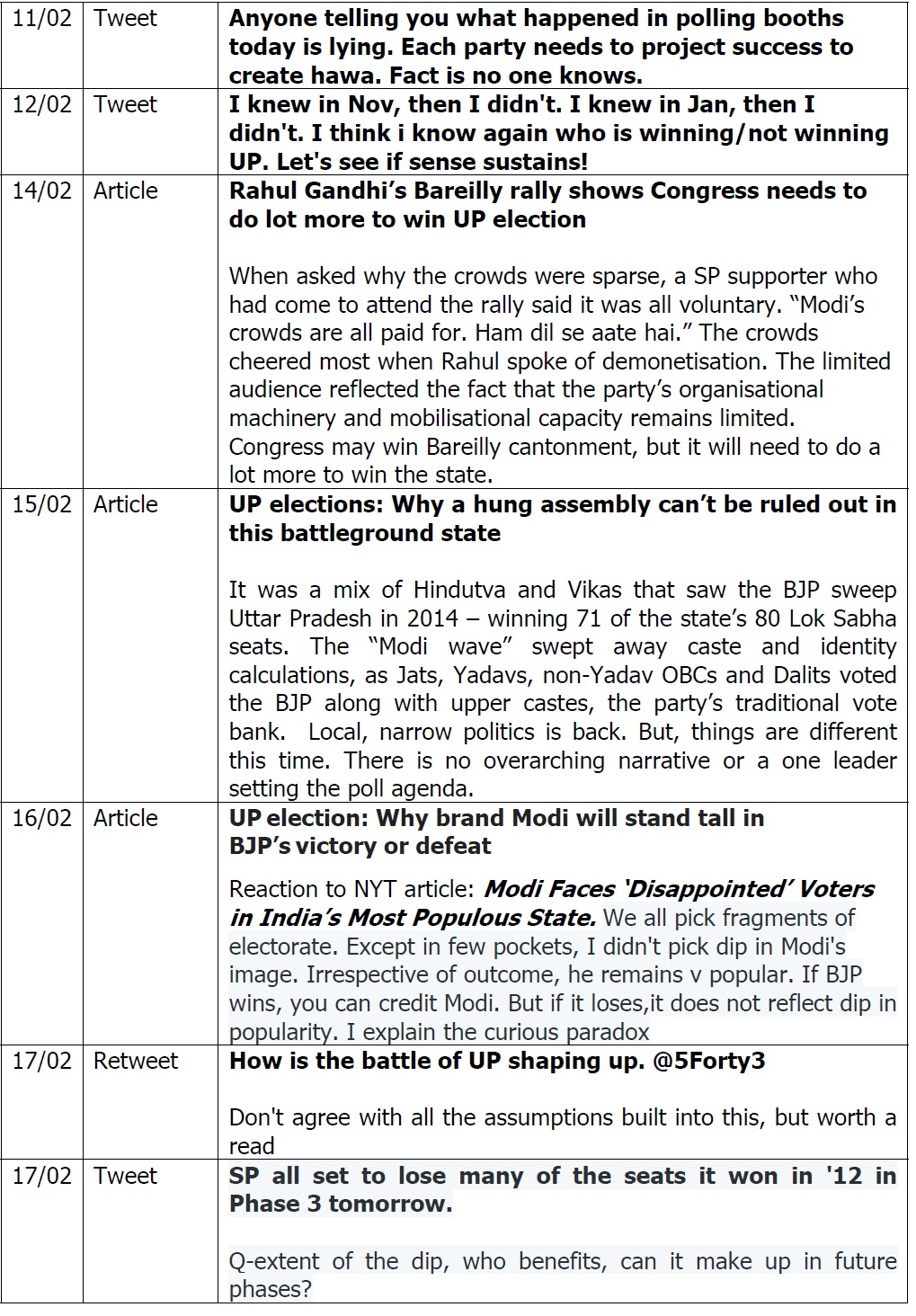
Two of the much followed on-the-ground reports are of Prashant Jha, Associate Editor Hindustan Times and Shivam Vij, Deputy Editor, HuffingtonPost. Prashant Jha appears more a prolific writer, penning more articles that slants more on commentaries and opinions that reflect certainty while Shivam Vij appears to adopt a more cautious reporting slant, fewer articles but adopts a more engaging style with his readers by his tweets, retweets and FaceBook conversations. 

Prashant Jha comes across as more inclined towards BJP while Shivam Vij is mostly considered independent. However, both during the election trail appeared to face some backlash from readers who accused them of political partisan writings, forcing them to defend themselves. Though some overlap of opinions between them are noticeable, there are also significant differences of perceptions and inferences  between the two however nuanced. While Jha appeared more prepared to play the game of certainty, Shivam Vij openly admitted that he was unable in this instance to meet the expectations of certainty but still manage to retain his reputation as one of sharpest among journalists on capturing the mood of the people.

While pollsters lend themselves easily to be evaluated for their accuracy through comparisons between their predictions and actual results, a similar method could be applied to on-the-ground reports of journalists if all their reports - articles, tweets, retweets are compiled as sort of a journal of their on-the-ground-report trail.  

For benefit of readers who are keen to assess the reliability of on-the-ground reports, we have compiled a month journal entries of Prashant Jha and Shivam Vij 

Read Part 2: UP Elections: How Reliable On-the-Ground Reporting? The Prashant Jha Journal (Click HERE)
Read Part 3: UP Elections: How Reliable On-the-Ground Reporting? The Shivam Vij Journal (Click HERE)

Like us on Facebook

Follow us on Twitter